
Presidio Projected Versus Actual Release
TDCJ defines Projected Release Date as the date calculated using the maximum sentence date, the nature of the offense, jail-time credit, and possible good-time credit. It is a forecast. It is not an actual prison departure entry. In some cases where mandatory supervision is unavailable or not approved, the projected date may equal the discharge date, but the label still must be preserved until a final record confirms the event.
Scheduled is not actual. A forecast, parole eligibility date, and favorable BPP vote do not prove that a person crossed the prison gate. A TDCJ release certificate or release history is stronger evidence.
A person held pretrial at Presidio County Jail may leave after bond, PR bond, dismissal, transfer, or court order. No verified county calculation policy or fixed release time supports estimating that exit.
Find Presidio Projected Release Dates
The live TDCJ inmate search covers current TDCJ prisoners only, warns that data is at least 24 hours old, and updates on working days. Search by TDCJ or SID number when possible, or by last name and first initial. For projected-date information, TDCJ also publishes a no-charge email-information route.
- Confirm whether the person is in county jail, TDCJ, federal custody, or another system.
- For TDCJ, preserve the TDCJ and SID numbers, offense, county, court, and retrieval date.
- Use the TDCJ information request for the exact Projected Release Date label.
- Compare the forecast with the judgment and applicable offense-date rules.
- For county custody, ask the jail for actual release records and the court for the controlling order.
- After state custody ends, request the release certificate or actual history.
The official TDCJ information page explains the forecast and request fields.
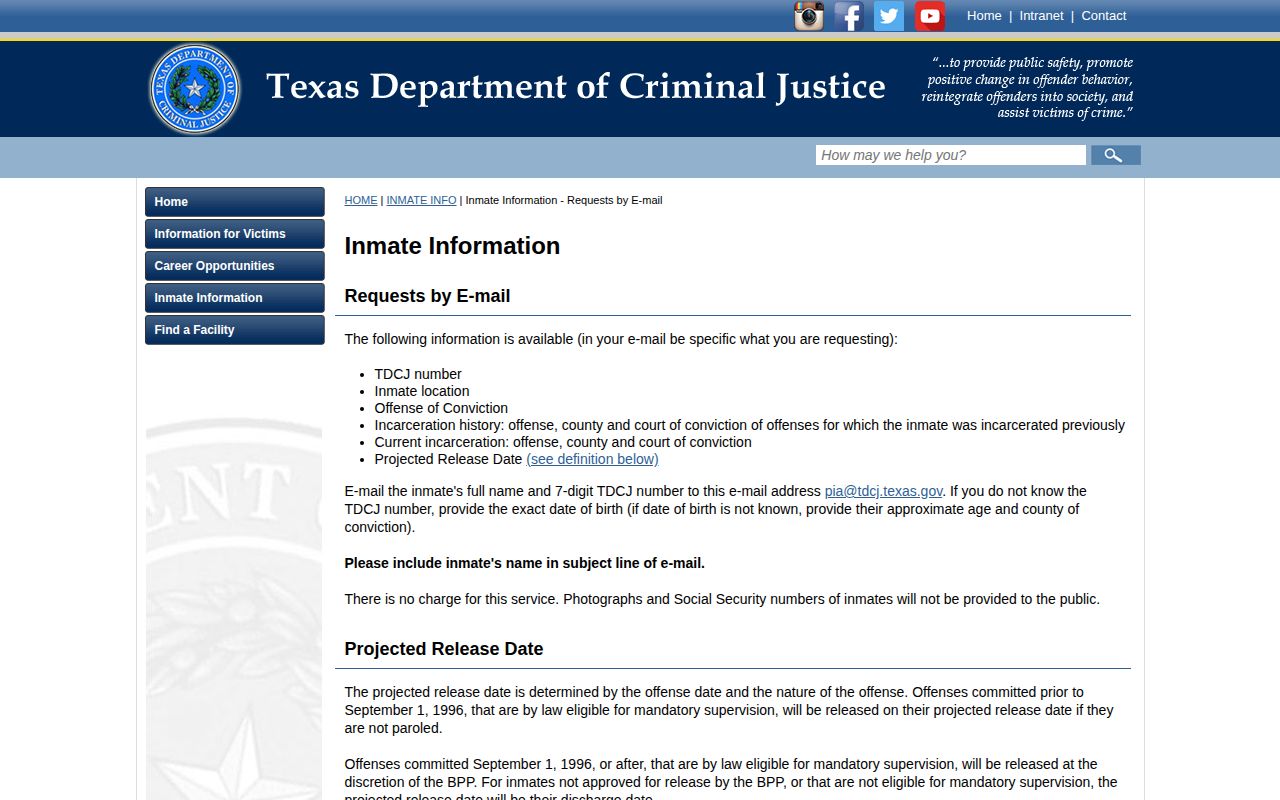
The displayed definition helps prevent a forecast from being reported as a completed release.
Texas Good Time for Presidio Cases
Texas has no blanket rule that every prisoner serves 85 percent of a sentence. Under Government Code §498.003, good conduct time is a privilege and does not reduce the sentence term itself. It affects eligibility for parole or mandatory supervision as the governing statutes allow. Classification and disciplinary history can affect credits.
Eligibility differs by offense and offense date. Government Code §§508.145, 508.147, and 508.149 govern major parts of parole and mandatory-supervision eligibility. For enumerated serious offenses, §508.145 commonly uses one-half of the sentence in actual calendar time, with a 30-year cap, before parole eligibility. That rule concerns eligibility for review, not a guaranteed exit date.
- Good time
- Administrative credit that can affect eligibility but does not shorten the sentence term.
- Parole eligibility
- The earliest point for consideration, not scheduled release.
- Mandatory supervision
- Release to supervision under statutory rules, subject to exclusions and review.
- Maximum sentence date
- The sentence endpoint before other lawful calculations and events are applied.
Why Presidio Release Forecasts Change
A forecast can move because the facts feeding the calculation change or because a separate custody barrier appears. Do not recalculate it from a sentence summary.
| Factor | Possible effect |
|---|---|
| Jail-time credit correction | Changes credited time in the official calculation |
| Good-time classification or loss | Changes eligibility calculations where allowed |
| Parole panel action | Can deny, set off, or approve subject to conditions |
| Detainer or warrant | May cause transfer or block community release |
| New court order | Can alter the controlling sentence or credit |
| Release-plan review | Can delay certificate processing after a favorable action |
Record the date each forecast was retrieved. An older date and a newer certificate may describe the same case at different stages.
Confirm Presidio Actual Release
For TDCJ departure, request the actual release or discharge date, method, incarceration history, and release certificate. Review and Release Processing verifies eligibility, file data, detainers, and release plans before the controlling certificate issues. A favorable vote alone is not enough.
For a county jail event, request the physical exit time, release reason, authority, and destination. If the destination is TDCJ, the person transferred into state custody. If it names federal or immigration authorities, use Federal and Immigration Custody. A VINELink Check can support prompt notice for a participating agency but does not replace the final record.
No Texas 85 Percent Rule
The claim that every Texas prisoner must serve 85 percent is unsupported. Statutory rules differ by offense, offense date, sentence, credit, and eligibility category. Some serious cases use the actual-time calculation described in §508.145; others follow different provisions.
Report only the official forecast and its retrieval date. If explaining eligibility, cite the section that governs the actual case and avoid predicting a BPP vote. Eligibility opens review; it does not compel release.
Presidio Jail Versus TDCJ Dates
County jail and state prison records should never be blended. The sheriff holds the local booking and physical release record. TDCJ controls its own forecast, incarceration history, parole processing, and certificate. A Presidio judgment can explain the sentence, but it is not the prison exit log.
When dates differ, place the order date, county transfer, TDCJ admission, forecast retrieval, BPP action, certificate, and supervision intake on a timeline. Several accurate dates can describe different events.
Presidio Release Certificate Evidence
TDCJ Review and Release Processing checks the file, eligibility, release-plan requirements, and detainers before preparing the certificate. That work explains why an approved parole action may not produce immediate departure.
Request the certificate or actual history after state custody ends. Preserve whether it says parole, mandatory supervision, discharge, or another method. Release to supervision is not full discharge.
If the current-only locator stops returning a person, do not call that discharge proof. Use the official records route, identifiers, and retrieval date.
Build a Presidio Release Timeline
Start with the judgment, jail credit, and TDCJ admission. Add each official forecast with its retrieval date. Record parole eligibility and the exact BPP action without turning either into a promised exit. Finish with certificate, departure, destination, and supervision intake.
A detainer may cause transfer to another agency. Describe the TDCJ departure and receiving custody separately. When dates conflict, ask what each represents. Court authority, calculation, physical exit, and receiving admission can all be accurate on different days.
Presidio Eligibility Is Not Exit
A parole eligibility date marks the earliest review point under the governing rules. BPP may deny release, set the case off for later review, approve with prerequisites, or record another vote code. Preserve that code and consult the agency's definition. A favorable action remains a decision point until release processing is complete.
Mandatory supervision also requires precise wording. It is a form of release to community supervision, not a declaration that the sentence has vanished. Section 508.149 excludes or subjects certain cases to review. Section 508.147 addresses the statutory release framework for eligible cases. The judgment, offense date, and official TDCJ calculation control.
Ordinary Texas parole consideration is generally a file-review and panel-voting process, not a public calendar that supplies a prison-gate date. Do not estimate departure from the date a file entered review. Use the BPP status route for the action and the certificate route for actual release.
Request Presidio Release Date Records
A TDCJ information request should include the person's full name, TDCJ number, SID number if known, date of birth when appropriate, and the precise fields sought. Ask for Projected Release Date, offense, county and court, incarceration history, actual release or discharge date, release method, and certificate as separate fields. The agency evaluates public-record requests, exemptions, and costs case by case.
For county custody, ask the sheriff for admission, actual release, authority, and destination. Ask the clerk for the judgment, bond order, sentence, and jail credit. Never ask either office to calculate a state forecast it does not own.
Save every retrieval date. Websites and forecasts change. A source that is silent should be described as silent, not treated as proof that the sentence ended.
Check Holds After Presidio Release
A projected TDCJ date addresses the state sentence calculation. It does not rule out an active detainer from another county, a federal warrant, immigration custody, or another sentence. Review and Release Processing checks detainers as part of the release work, but the receiving agency's record proves what happened after departure.
For a transfer, ask both the sending and receiving custodians for records. Preserve the state certificate and the next admission as two events. If the destination is unclear, do not call it community release.
The same caution applies to county jail. A Presidio exit labeled TDCJ is a state transfer, while a USMS or ICE destination begins a different custody layer. The projected-date source must always be named.
Search Public Records
Sponsored Results